Learning objects or units categorization
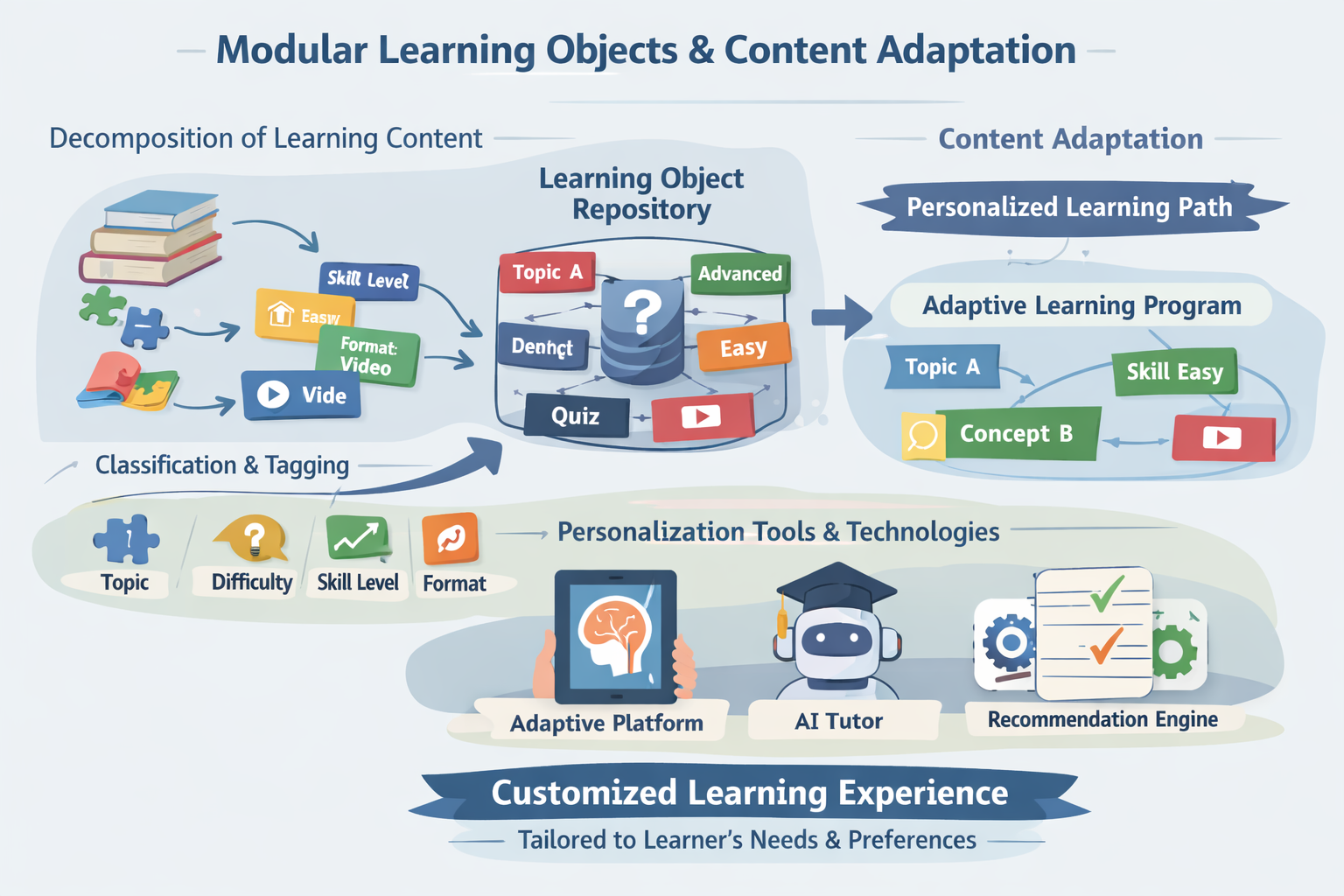
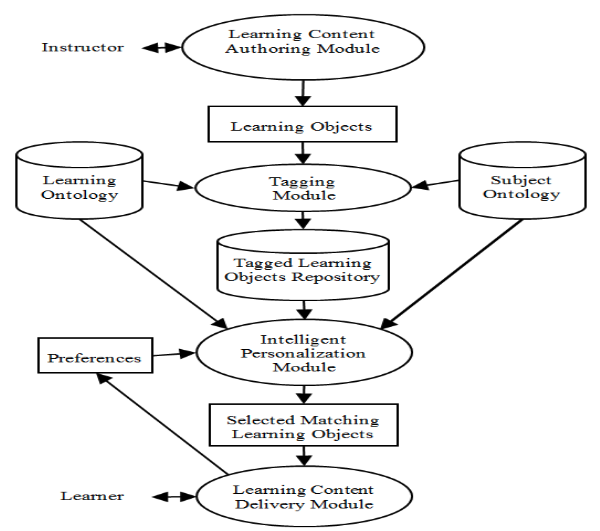
This process involves the creation of personalised learning materials through the generation of dynamic pages created by decomposing learning content into smaller, well-defined units, commonly known as learning units (LUs) or learning objects (LOs). It also involves the classification of these learning objects using various attributes, which may include topic, concept, skill level, difficulty, format, or other relevant characteristics, depending on the subject and learning context.
Content adaptation involves the adaptive generation and assembly of these individual learning objects. The organised components can then be utilised by personalised learning tools and technologies to achieve effective personalisation. Through this structured approach, learning systems can dynamically select and combine learning objects to create personalised learning programmes.
A single subject can therefore be represented by multiple learning objects, allowing learners to engage with content that best matches their needs and preferences.
Resources
References
- Alhawiti, M. M., & Abdelhamid, Y. (2017). A Personalized e-Learning Framework. Journal of Education and E-Learning Research, 4(1), 15-21.
- De Meo, P., Garro, A., Terracina, G., & Ursino, D. (2007). Personalizing learning programs with X-Learn, an XML-based, “user-device” adaptive multi-agent system. Information Sciences, 177(8), 1729–1770. https://doi.org/10.1016/j.ins.2006.10.005
- Gasparetti, F., De Medio, C., Limongelli, C., Sciarrone, F., & Temperini, M. (2018). Prerequisites between learning objects: Automatic extraction based on a machine learning approach. Telematics and Informatics, 35(3), 595–610. https://doi.org/10.1016/j.tele.2017.05.007
- Gutiérrez, I., Álvarez, V., Paule, M. P., Pérez-Pérez, J. R., & De Freitas, S. (2016). Adaptation in e-learning content specifications with dynamic sharable objects. Systems, 4(2), 24.
- Murray, M. C., & Pérez, J. (2015). Informing and performing: A study comparing adaptive learning to traditional learning. Informing Science, 18(1), 111–125. https://doi.org/10.28945/2165
- Wanapu, S., Fung, C. C., Kerdprasop, N., Chamnongsri, N., & Niwattanakul, S. (2016). An investigation on the correlation of learner styles and learning objects characteristics in a proposed Learning Objects Management Model (LOMM). Education and Information Technologies, 21(5), 1113–1134. https://doi.org/10.1007/s10639-014-9371-3